
Incense box
Unknown Artist
19th century, after 1632 original
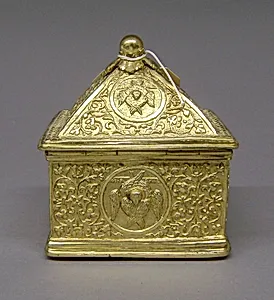
Medium
Silver on base metal
Dimensions
Height: 4 3/4 in. (12.1 cm)
Classification
Metalwork-Electrotype
Culture
British, after Russian original
Department
European Sculpture and Decorative Arts
Museum
Metropolitan Museum of Art, New York, NY
Credit
Gift of Henry G. Marquand, 1883
Accession Number
83.18.206
Rights
Public Domain
Tags
Art Historical Context
This elegant incense box, a 19th-century British electrotype reproduction of a Russian original dating after 1632, exemplifies artistry of historical metalwork. Crafted in silver over base metal and standing just 4 3/4 inches tall, it features intricate decorations of faces and leaves, evoking ornate style of early modern Russian decorative arts. Likely used in religious or ceremonial contexts, such boxes held incense for liturgical rites, blending functionality with symbolic beauty. Electrotyping, the innovative 19th-century technique used, involved electrochemically depositing a thin silver layer onto a mold of the original, creating precise, affordable replicas. This allowed collectors like Henry G. Marquand—whose 1883 gift brought it to The Metropolitan Museum of Art—to share treasures from distant cultures without risking irreplaceable artifacts. Popular in Victorian Britain, these copies democratized access to Renaissance and Baroque masterpieces. Housed in the Met's Department of European Sculpture and Decorative Arts, this piece highlights cross-cultural exchange: a Russian design reimagined for British audiences. Its delicate motifs of faces and foliage whisper of folklore and nature's harmony, inviting visitors to ponder the enduring allure of scented rituals in history.