
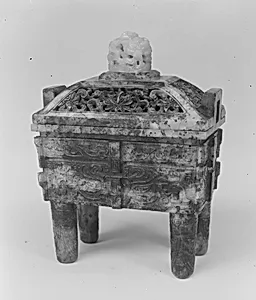
Incense burner
Unknown Artist
Medium
Nephrite
Dimensions
H. 7 1/2 in. (19.1 cm); W. 6 in. (15.2 cm)
Classification
Jade
Culture & Period
China · Qing dynasty (1644–1911), Qianlong period (1736–95)
Department
Asian Art
Museum
Metropolitan Museum of Art, New York, NY
Credit
Bequest of Edmund C. Converse, 1921
Accession Number
21.175.149a, b
Rights
Public Domain
Art Historical Context
This exquisite nephrite jade incense burner, hailing from China's Qing dynasty during the Qianlong period (6–95), exemplifies the imperial era's mastery of luxury craftsmanship. Standing at 7½ inches tall and 6 inches wide, its smooth, translucent green stone—nephrite, a prized of jade revered for its toughness and luminous quality—was meticulously carved into a functional yet ornamental vessel. Such burners were essential in scholarly studios, temples, and elite households, where fragrant incense wafted during rituals, meditation, or social gatherings. The Qianlong reign marked a golden age for jade carving, with the emperor's patronage fueling workshops that produced objects blending utility and artistry. Nephrite's hardness demanded skilled lapidaries using abrasives and fine tools to achieve intricate details, often evoking natural motifs like mythical beasts or archaistic designs inspired by ancient bronzes. This piece reflects the period's aesthetic of refinement and imperial splendor, symbolizing purity, prosperity, and harmony in Chinese cosmology. Today, housed in the Metropolitan Museum of Art's Asian Art Department through the 1921 bequest of Edmund C. Converse, it invites us to appreciate the enduring allure of Qing jade— a testament to artistry that transcended time.