
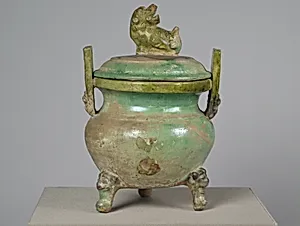
Incense Burner
Unknown Artist
Medium
Pottery
Dimensions
H. 6 5/8 in. (16.8 cm); W. 4 3/8 in. (11.1 cm)
Classification
Ceramics
Culture & Period
China · Ming dynasty (1368–1644)
Department
Asian Art
Museum
Metropolitan Museum of Art, New York, NY
Credit
Gift of Joseph Koshland, 1924
Accession Number
24.55.3a, b
Rights
Public Domain
Tags
Art Historical Context
This charming incense burner, crafted in pottery during China's Ming dynasty (13681644), exemplifies the's masterful ceramics tradition. Standing just 6⅝ inches tall and 4⅜ inches wide, its compact form suggests it was designed for intimate domestic or ritual use, possibly adorned with animal motifs—a common feature in Ming wares that infused everyday objects with symbolic vitality. Produced in an age when China led the world in ceramic innovation, such pieces highlight the dynasty's technical prowess in shaping durable, elegant vessels from clay. Ming incense burners held deep cultural significance, often employed in Buddhist temples, ancestral altars, or scholarly studios to diffuse fragrant smoke during meditation, offerings, or social gatherings. The animal tags evoke the playful yet auspicious zoomorphic designs popular then, like lions or mythical beasts believed to ward off evil and invite prosperity. Though the artist remains unknown, the burner's survival speaks to the enduring appeal of Ming ceramics, prized globally for their refined glazes and forms. Generously gifted to the Metropolitan Museum of Art by Joseph Koshland in 1924, this artifact invites us to imagine the aromatic rituals of imperial China, bridging ancient craftsmanship with modern appreciation in the Asian Art collection.