
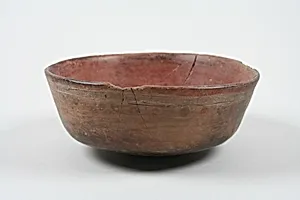
Incised bowl
Unknown Artist
6th–4th century BCE
Medium
Ceramic, pigment
Dimensions
H. 2 1/8 × Diam. 5 1/2 in. (5.4 × 14 cm)
Classification
Ceramics-Containers
Culture
Paracas
Department
Arts of Africa, Oceania, and the Americas
Museum
Metropolitan Museum of Art, New York, NY
Credit
Gift of Nathan Cummings, 1962
Accession Number
62.266.31
Rights
Public Domain
Art Historical Context
This delicate incised bowl hails from the Paracas culture of ancient Peru's south coast, crafted between the 6th and 4th centuries BCE Measuring just 2⅛ inches high and 5½ inches in diameter, this small ceramic vessel with pigment accents was likely used for everyday or ritual purposes, reflecting the Paracas people's mastery of pottery during Peru's Early Horizon period. The bowl's standout feature is its incising technique: artisans carved intricate designs into the leather-hard clay surface before firing, creating textured motifs that were then highlighted with pigments, often in red and black tones. This method produced durable, visually striking ceramics that distinguished Paracas pottery from neighboring styles, emphasizing geometric patterns and symbolic forms tied to their worldview. As part of the Metropolitan Museum of Art's Arts of Africa, Oceania, and the Americas collection—gifted by Nathan Cummings in 1962—this bowl offers a window into Paracas innovation. Renowned for elaborate textiles and mummy bundles, the culture's ceramics like this one underscore their artistic versatility, bridging utility and aesthetics in pre-Inca Andean life.