
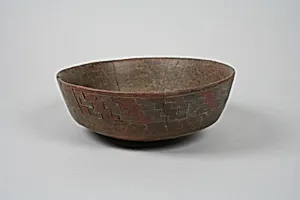
Incised bowl with geometric pattern
Unknown Artist
6th–4th century BCE
Medium
Ceramic, pigment
Dimensions
H. 2 1/4 × Diam. 6 5/8 in. (5.7 × 16.8 cm)
Classification
Ceramics-Containers
Culture
Paracas
Department
Arts of Africa, Oceania, and the Americas
Museum
Metropolitan Museum of Art, New York, NY
Credit
Gift of Nathan Cummings, 1962
Accession Number
62.266.30
Rights
Public Domain
Art Historical Context
This delicate incised bowl, crafted by an unknown Paracas artist between the 6th and 4th centuries BCE, offers a window into the vibrant world of ancient Peru's south coast. The Paracas culture, flourishing from around 800 to 100 BCE, was renowned for its sophisticated textiles and ceramics, with early examples like this one showcasing a mastery of geometric abstraction. Housed in the Metropolitan Museum of Art's Department of Arts of Africa, Oceania, and the Americas, this ceramic container—measuring just 2¼ inches high and 6⅝ inches in diameter—was generously gifted by Nathan Cummings in 1962. The bowl's surface features intricate geometric patterns incised into the clay before firing, a technique that highlights the Paracas people's technical skill and aesthetic restraint. Subtle pigments enhance the designs, creating subtle contrasts that catch the light. These motifs—repeating lines, zigzags, and interlocking shapes—likely held symbolic importance, possibly evoking natural forces or spiritual concepts central to Paracas cosmology. As a functional yet artistic vessel, it reflects everyday life intertwined with ritual in pre-Inca society. Such bowls were used for serving food or offerings, bridging the mundane and the sacred. Today, it stands as a testament to the Paracas legacy of innovation, reminding us how ancient hands shaped enduring beauty from humble clay.