
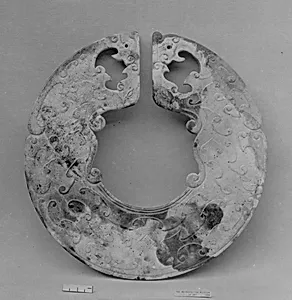
Incomplete Ring
Unknown Artist
Medium
Jade
Dimensions
Diam. 8 1/2 in. (21.6 cm)
Classification
Jade
Culture & Period
China · Han dynasty (206 B.C.–A.D. 220)
Department
Asian Art
Museum
Metropolitan Museum of Art, New York, NY
Credit
Fletcher Fund, 1925
Accession Number
25.145.1
Rights
Public Domain
Art Historical Context
Welcome to the Metropolitan Museum of Art's Asian Art collection, where the enigmatic *Incomplete Ring* transports us to China's Han dynasty (206 B.C.–A.D. 220). Crafted from lustrous jade, this substantial piece measures 8½ inches in diameter and stands as a testament to the era's masterful stonework. The Han period marked a golden age for jade carving, with artisans transforming the tough, resilient stone—often nephrite sourced from distant mountains—into objects of profound ritual and symbolic power. Jade held immense cultural significance in ancient China, embodying purity, immortality, and harmony between heaven and earth. Circular rings like this one, known as *bi* discs, were central to cosmology and funerary practices; the perfect circle evoked the heavens, while its placement over the deceased ensured spiritual protection. The "incomplete" form of this ring adds intrigue—perhaps intentionally designed or a relic of use—highlighting the Han's innovative techniques, such as precise drilling and polishing that brought out jade's translucent glow. Acquired through the Fletcher Fund in 1925, this artifact invites reflection on Han society's reverence for jade as a bridge between the mortal and divine. Gaze closely, and feel the weight of millennia in its smooth, enduring curve.