
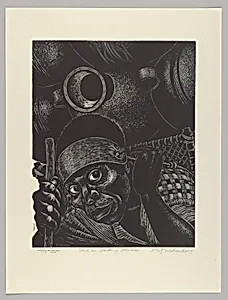
Indian Pottery Vendor
1935–43
Medium
Wood engraving
Dimensions
block: 10 x 7 3/4 in. (25.4 x 19.7 cm) sheet: 13 3/4 x 10 1/4 in. (34.9 x 26 cm)
Classification
Prints
Department
Drawings and Prints
Museum
Metropolitan Museum of Art, New York, NY
Credit
Gift of the Work Projects Administration, New York, 1943
Accession Number
43.33.81
Rights
Public Domain
Tags
Art Historical Context
Created during the Great Depression as part of the Works Progress Administration’s art program, *Indian Pottery Vendor* captures a moment of everyday commerce with quiet dignity. Fritz Eichenberg, a German-born printmaker who emigrated to the United States in 1933, contributed this wood engraving to the WPA between 1935 and 1943. The project aimed to employ artists while documenting American life, and the resulting prints were distributed to public institutions, including the Metropolitan Museum of Art, which received this impression as a gift in 1943. The medium of wood engraving lends itself to crisp contrasts and intricate textures, allowing Eichenberg to render the stacked pottery, the vendor’s clothing, and the surrounding figures with remarkable clarity. Though the precise setting remains open to interpretation, the title and the presence of male figures suggest a scene centered on trade—possibly highlighting Native American artisans or merchants whose work was part of regional economies in the 1930s and 1940s. Eichenberg’s choice of wood engraving reflects both practical and expressive concerns: the technique produces durable printing blocks that could generate many impressions for wide circulation, aligning perfectly with the WPA’s goal of bringing art to the public. Today the print stands as a modest yet telling record of that era’s social and cultural landscape.
About the Artist
Fritz Eichenberg|WPA (American| ) · 1901 | –1990 |
American, Cologne, Germany 1901–1990 Peace Dale, Rhode Island|