
Indian Woman
1935/1942
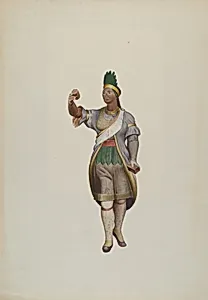
Medium
watercolor, graphite, and colored pencil on paper
Dimensions
overall: 54.4 x 38 cm (21 7/16 x 14 15/16 in.)
Classification
Index of American Design
Department
CG-W
Museum
National Gallery of Art, Washington, D.C.
Credit
Index of American Design
Accession Number
1943.8.10100
Rights
Public Domain
Art Historical Context
**Indian Woman**, created between 1935 and 1942 by an anonymous American 20th-century artist, is a captivating watercolor, graphite, and colored pencil rendering on paper, measuring 21 7/16 x 14 15/16 inches. Housed in the National Gallery of Art's Index of American Design collection, this work exemplifies the meticulous documentation style of the era, blending fine artistry with scholarly precision to capture cultural motifs. Part of the Federal Art Project under the Works Progress Administration (WPA) during the Great Depression, the Index of American Design commissioned over 15,000 such illustrations to preserve America's diverse artistic heritage—from folk crafts to Native American influences. Completed amid economic hardship, these pieces employed unemployed artists to highlight everyday designs, ensuring their legacy for future generations. Here, the "Indian Woman" likely draws from Indigenous motifs integral to American craft traditions, reflecting a broader appreciation for Native contributions to the nation's visual culture. The mixed media technique shines in its vibrant yet accurate color reproduction and intricate graphite details, allowing viewers to study patterns and forms as if examining the original object. This artwork invites us to ponder the intersection of cultural identity and national pride, reminding visitors of art's power to safeguard history.
About the Artist
American 20th Century · 1900–1999
"American 20th Century" is the designation used by major institutions such as the National Gallery of Art (NGA) for anonymous and unidentified artists active in the United States during the twentieth century. The artist's personal identity, early life, and training remain undocumented, reflecting the challenges of attribution for unattributed works from this era. No specific teachers, art schools,...