
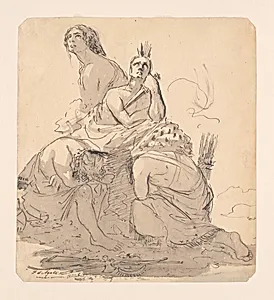
Indians Lamenting the Approach of the White Man (from McGuire Scrapbook)
ca. 1830
Medium
Pen and black ink, gray washes, and graphite on off-white wove paper
Dimensions
8 7/8 x 8 1/16 in. (22.5 x 20.5 cm)
Classification
Drawing
Culture
American
Department
The American Wing
Museum
Metropolitan Museum of Art, New York, NY
Credit
Gift of James C. McGuire, 1926
Accession Number
26.216.3 recto
Rights
Public Domain
Tags
Art Historical Context
In the early 19th century, American expansion westward accelerated, Frederick Stiles Agate a poignant moment of cultural collision in *Indians Lamenting the of the White Man* (ca. 1830). This intimate drawing, part of the McGuire Scrap, depicts Native American men expressions of profound sadness, gazing toward an encroaching horizon that symbolizes the arrival of white settlers. Agate, an American artist known for his detailed landscapes and portraits, uses the work to evoke the human cost of Manifest Destiny, a theme resonant during the era of the Indian Removal Act of 1830. Rendered in pen and black ink with subtle gray washes and graphite on off-white wove paper (8 7/8 x 8 1/16 in.), the piece exemplifies the expressive power of monochromatic drawing techniques. The fluid ink lines and layered washes create depth and shadow, heightening the emotional weight of the figures' lament—furrowed brows, slumped postures, and distant stares that convey inevitable loss. As a preparatory or standalone sketch, it highlights the scrapbook tradition among collectors, preserving ephemeral artistic insights. Today, housed in The Metropolitan Museum of Art's American Wing (gift of James C. McGuire, 1926), this work invites reflection on indigenous resilience amid displacement, blending artistic skill with a stark commentary on America's formative tensions.