
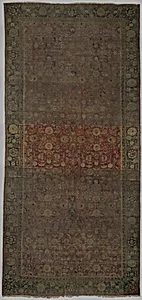
Indo-Persian carpet with repeat pattern of vine scrolls and palmettes.
Unknown Artist
second half of the 17th century
Medium
Wool pile on cotton foundation.
Dimensions
Length: 6.5 m. Width: 3 m.
Classification
Textiles-Rugs
Culture
Indo-Persian
Department
Robert Lehman Collection
Museum
Metropolitan Museum of Art, New York, NY
Credit
Robert Lehman Collection, 1975 1975.1.2460
Accession Number
1975.1.2460
Rights
Public Domain
Art Historical Context
This magnificent Indo-Persian carpet woven in the second half of the17th century, exemplifies opulent textile arts of the Mughal Empire. Measuring an impressive 6.5 in length and 3 meters width, it features a pattern of sinuous vine scrolls and paltes—motifs inspired by Persian garden traditions symbolizing paradise and eternal growth. Crafted with a wool pile on a cotton foundation, its dense knotting technique creates a luxurious, durable surface ideal for grand palaces or elite homes. Produced during a golden age of cultural exchange between India and Persia, the carpet reflects the Mughal court's fascination with Safavid designs, adapted by Indian weavers. The cotton foundation points to regional workshops in northern India, where artisans blended Persian aesthetics with local materials and skills, producing rugs that adorned imperial floors and influenced global trade in luxury goods. Today, housed in the Robert Lehman Collection at The Metropolitan Museum of Art (1975.1.2460), this piece invites visitors to imagine the vibrant courts of Shah Jahan's successors, where such carpets were status symbols woven with meticulous precision—often taking years to complete. A testament to cross-cultural artistry, it continues to captivate with its timeless elegance.