
Inigo Jones
1769–80
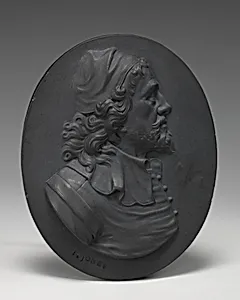
Medium
Black basalt ware
Dimensions
3 1/4 × 2 5/8 in. (8.3 × 6.7 cm)
Classification
Ceramics-Pottery
Culture
British, Etruria, Staffordshire
Department
European Sculpture and Decorative Arts
Museum
Metropolitan Museum of Art, New York, NY
Credit
Purchase, Joseph Pulitzer Bequest, 1942
Accession Number
42.76.42
Rights
Public Domain
Tags
Art Historical Context
Wedgwood and Bentley's *Inigo Jones* (1769–80) is a exquisite example of black basalt ware, a fine unglazed stoneware invented by Josiah Wedgwood to evoke the somber elegance of ancient Greek and Roman pottery. This profile medallion, measuring just 3¼ × 2⅝ inches, captures the likeness of Inigo Jones (1573–1652), the pioneering English architect who introduced Palladian classicism to Britain with masterpieces like the Queen's House at Greenwich. Produced at Wedgwood's Etruria factory in Staffordshire, it reflects the neoclassical revival sweeping 18th-century Europe. The matte black finish of black basalt, achieved through a precise mix of clay, flint, and manganese, allowed for sharp, cameo-like relief portraits that mimicked classical gems and intaglios. Wedgwood and his partner Thomas Bentley mass-produced these affordable luxury items for enlightened collectors, blending industrial innovation with artistic aspiration. This piece honors Jones as a cultural hero, linking Renaissance humanism to Georgian tastes. Today, housed in The Metropolitan Museum of Art's European Sculpture and Decorative Arts department, it exemplifies how British ceramics bridged antiquity and modernity, making classical ideals accessible to a wider audience. A testament to Wedgwood's genius, it invites us to admire the architect's enduring legacy in miniature form.