
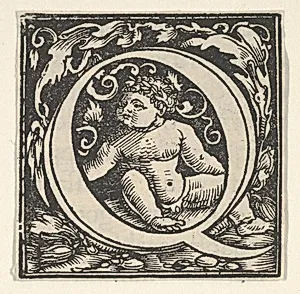
Initial letter Q with putto
ca. 1538
Medium
Woodcut
Dimensions
Sheet: 1 7/8 × 1 7/8 in. (4.8 × 4.7 cm)
Classification
Prints|Ornament & Architecture
Department
Drawings and Prints
Museum
Metropolitan Museum of Art, New York, NY
Credit
Purchase, Anne and Carl Stern Gift, 1959
Accession Number
59.507.3(13)
Rights
Public Domain
Art Historical Context
This delicate woodcut by Heinrich Vogtherr the Elder presents an ornate initial “Q” inhabited by a playful putto, a common Renaissance motif of a winged cherub. Created around1538, the tiny—measuring just under two inches square—belongs to a category of ornamental designs intended for use in books, architectural decoration, and other applied arts. Vogtherr, a German artist active during the Reformation, specialized in such model prints that combined letterforms with lively figures, making sophisticated ornament accessible to craftsmen and printers across Europe. Woodcut technique was ideally suited to this purpose: the artist carved the design in relief on a wooden block, allowing multiple impressions to be pulled quickly and inexpensively. The resulting crisp lines and compact composition demonstrate Vogtherr’s skill at balancing decorative flourish with legible typography, a hallmark of sixteenth-century ornament prints classified under both “Prints” and “Ornament & Architecture.” Today preserved in the Metropolitan Museum’s Department of Drawings and Prints, the sheet exemplifies how Renaissance artists bridged fine art and functional design. Its survival as a single sheet reminds us of the widespread circulation of such models, which helped spread Renaissance motifs far beyond the workshops where they originated.