
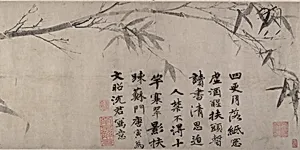
明 唐寅 墨竹圖 卷|Ink bamboo
early 16th century
Medium
Handscroll; ink on paper
Dimensions
Image: 11 7/16 × 59 1/8 in. (29.1 × 150.2 cm) Overall with mounting: 11 7/8 in. × 24 ft. 1 9/16 in. (30.2 × 735.5 cm)
Classification
Paintings
Culture & Period
China · Ming dynasty (1368–1644)
Department
Asian Art
Museum
Metropolitan Museum of Art, New York, NY
Credit
Bequest of John M. Crawford Jr., 1988
Accession Number
1989.363.54
Rights
Public Domain
Tags
Art Historical Context
**Ink Bamboo by Tang Yin** This exquisite handscroll, *Ink Bamboo* (Ming dynasty, early 16th century), showcases the mastery of Tang Yin (1470–1523), a renowned Chinese painter, poet, and calligrapher from Suzhou. Created with ink on paper, the work measures an impressive 59 inches in image length, designed to unroll gradually for an intimate, meditative viewing experience. Tang Yin, often called Tang Bohu, was a leading figure in the Wu school of literati painting, emphasizing personal expression over professional polish, drawing from nature's simplicity. Bamboo holds profound cultural symbolism in Chinese art, embodying virtues like resilience, integrity, and humility—qualities revered in Confucian ideals. Tang Yin's fluid, minimalist ink strokes capture the plant's swaying stalks and delicate leaves with remarkable vitality, using varied brushwork to suggest depth, movement, and texture on the flat paper surface. This technique reflects the scholar-artist's harmony with nature, a hallmark of Ming literati tradition. Now housed in the Metropolitan Museum of Art's Asian Art Department (Bequest of John M. Crawford Jr., 1988), this scroll invites viewers to ponder the timeless elegance of ink monochrome painting, bridging artistry and philosophy in Ming China.
About the Artist
Tang Yin · 1470–1524
Talented painter whose career as an official painter was ruined by an examination scandal in 1499. Around 1500 he began to study painting with Zhou chen. He was ultimately considered one of the Four Masters of the Ming, along with Shen Zhou, Wen Zhengming and Qiu Ying.