
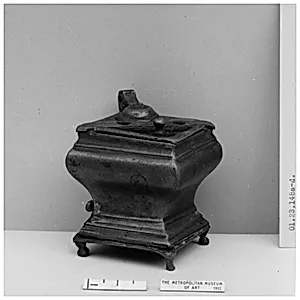
Inkstand
Unknown Artist
17th–18th century
Medium
Pewter
Dimensions
Overall: 2 7/8 × 2 1/4 in. (7.3 × 5.7 cm)
Classification
Metalwork-Pewter
Culture
possibly French or Dutch
Department
European Sculpture and Decorative Arts
Museum
Metropolitan Museum of Art, New York, NY
Credit
Bequest of Henry Victor Burgy, 1901
Accession Number
01.23.148a–d
Rights
Public Domain
Art Historical Context
This petite pewter inkstand, dating to the 17th–18th century, exemplifies refined metalwork of European decorative arts possibly from France or the Netherlands. Measuring just 2 7/8 × 2 1/4 inches, it served as a practical desk accessory for writers and scholars, typically holding ink, quills, and sealing wax. Such objects bridged utility and elegance, adorning studies and offices during an era when literacy and correspondence boomed amid Enlightenment ideals and expanding trade. Crafted from pewter—an affordable alloy of tin, lead, and antimony— the inkstand reflects the medium's popularity in Northern Europe. Prized for its silvery sheen and malleability, pewter allowed artisans to create intricate forms without the expense of silver, making luxury accessible to the burgeoning middle class. Though the maker remains unknown, its survival speaks to the durability of these everyday treasures, now housed in The Metropolitan Museum of Art's European Sculpture and Decorative Arts department, thanks to the 1901 bequest of Henry Victor Burgy. Imagine dipping a quill into its well by candlelight—this unassuming piece whispers of a world where writing was both art and necessity, connecting us to the scribbles of history's thinkers.