
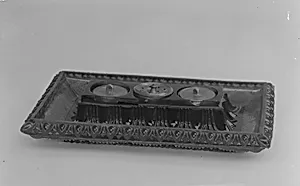
Inkstand
Unknown Artist
1800–1900
Medium
Lacy pressed blue glass, pewter
Dimensions
5 1/16 x 8 1/8 in. (12.9 x 20.6 cm)
Classification
Inkstand
Department
The American Wing
Museum
Metropolitan Museum of Art, New York, NY
Credit
Gift of Mrs. Charles W. Green, in memory of Dr. Charles W. Green, 1951
Accession Number
51.171.98a–f
Rights
Public Domain
Art Historical Context
This delicate inkstand, crafted between 1800 and 1900 by an unknown American artisan, exemplifies the ingenuity of early 19th-century decorative arts Measuring just over 5 inches high and 8 inches wide, it features lacy pressed blue glass—a technique pioneered in the United States around the 1820s, where molten glass was pressed into intricate molds to create fine, lace-like patterns. The vibrant cobalt blue hue, combined with functional pewter elements like a lid or fittings, made it both a practical writing accessory and a charming table ornament for middle-class homes. Lacy pressed glass, often associated with factories like those in Sandwich, Massachusetts, represented a democratic innovation: it mimicked expensive cut glass at a fraction of the cost, bringing beauty to everyday life. Inkstands like this one held inkwells for quill pens during an era when letter-writing and ledger-keeping flourished amid America's expanding literacy and commerce. Housed in The Metropolitan Museum of Art's American Wing, this piece was generously gifted in 1951 by Mrs. Charles W. Green in memory of her husband, Dr. Charles W. Green. It invites us to appreciate how humble objects captured the optimism and craftsmanship of a young nation.