
Inkstand
1710–20
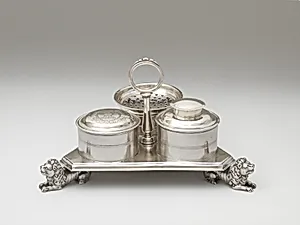
Medium
Silver
Dimensions
Overall: 4 1/8 x 6 1/2 in. (10.5 x 16.5 cm); 23 oz. 14 dwt. (736.7 g) Glass ink pot with silver cover: 1 3/4 x 2 1/4 in. (4.4 x 5.7 cm); 4 oz. 12 dwt. (143.3 g) Pounce pot: 1 1/8 x 2 5/8 in. (2.9 x 6.7 cm); 2 oz. 10 dwt. (78.2 g) Wafer pot cover: 9/16 x 2 5/16 in. (1.4 x 5.9 cm); 1 oz. 2 dwt. (34.5 g) Stand and attached parts: 15 oz. 9 dwt. (480.7 g)
Classification
Inkstand
Culture
American
Department
The American Wing
Museum
Metropolitan Museum of Art, New York, NY
Credit
Bequest of Charles Allen Munn, 1924
Accession Number
24.109.36a–d
Rights
Public Domain
Art Historical Context
This exquisite silver inkstand, crafted by Boston silversmith John Coney around 1710–20, exemplifies the pinnacle of early American colonial metalwork. Coney, one of the foremost silversmiths of his era, produced pieces that rivaled the finest English imports, blending functionality with refined elegance. Made entirely of silver and weighing nearly 24 ounces, the inkstand measures 4 1/8 x 6 1/2 inches overall, showcasing the material's luster and durability prized by affluent 18th-century households. Composed of a central stand supporting a glass ink pot with silver cover, a pounce pot for blotting ink, a wafer pot cover for sealing documents, and attached elements, this desk accessory was essential for correspondence in an age before modern pens. Its precise construction—detailed in components like the 4-ounce ink pot and 15-ounce stand—highlights advanced silversmithing techniques, including casting, chasing, and soldering. Housed in The Metropolitan Museum of Art's American Wing, it reflects the growing sophistication of American decorative arts during Queen Anne influences, symbolizing status and literacy among colonial elites. Bequeathed by collector Charles Allen Munn in 1924, the inkstand offers a tangible link to everyday luxury in early America, inviting visitors to imagine quill pens scratching across parchment in candlelit studies.