
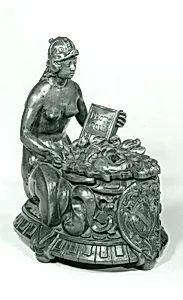
Inkwell
Unknown Artist
late 16th century
Medium
Copper alloy with light reddish brown patina and remains of a black lacquer patina.
Dimensions
H. 13.3 cm.
Classification
Metalwork-Bronze
Culture
Italian, Veneto (Verona?)
Department
Robert Lehman Collection
Museum
Metropolitan Museum of Art, New York, NY
Credit
Robert Lehman Collection, 1975
Accession Number
1975.1.1372
Rights
Public Domain
Tags
Art Historical Context
This elegant inkwell, crafted in the late 16th century in the Veneto region of Italy—possibly Verona—exempl the refined metalwork traditions of the Italian Renaissance. Standing just 13.3 centimeters tall, the copper alloy piece features a light reddish-brown patina with traces of black lac, highlighting the skilled casting techniques used to create durable yet decorative objects for daily use. Such inkwells were prized by scholars and nobles, blending practicality with artistic expression in a period when writing was both a craft and a status symbol. The work’s decorative program includes female nudes and a coat of arms, suggesting it was likely commissioned for a specific family or institution. These motifs reflect the Renaissance fascination with classical mythology and allegory, where the human form symbolized beauty, knowledge, or virtue. The inclusion of a heraldic emblem further personalizes the object, turning a utilitarian item into a statement of identity and patronage. As part of the Metropolitan Museum of Art’s Robert Lehman Collection, this bronze serves as a window into the material culture of 16th-century Italy. Its modest scale and intricate details demonstrate how artists elevated everyday objects into miniature sculptures, valued for both their function and their ability to convey cultural ideals of learning and refinement.