
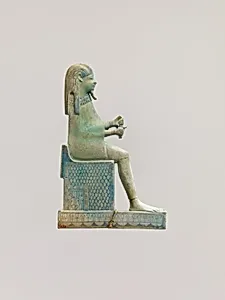
Inlay depicting the god Shepsi
Unknown Artist
4th century B.C.
Medium
Faience
Dimensions
H. 15.3 cm (6 in.); W. 10 cm (3 15/16 in.); D. 1 cm (3/8 in.)
Classification
Inlay, god Shepsi
Period
Late Period–Ptolemaic Period
Department
Egyptian Art
Museum
Metropolitan Museum of Art, New York, NY
Credit
Rogers Fund, 1918
Accession Number
18.2.8
Rights
Public Domain
Art Historical Context
Behold this exquisite faience inlay depicting the god Shepsi, a small yet vibrant artifact from Egypt's Late Period–Pmaic Period (4th century B.C.). just 15.3 cm high, 10 cm wide, and 1 cm deep, this ceramic piece—acquired through the Rogers Fund in 1918 and now housed in the Metropolitan Museum of Art's Egyptian Art Department—was likely designed to adorn a larger object, such as shrine furniture, a coffin, or temple decoration. Faience, made from crushed quartzite coated in brilliant turquoise or blue glaze, mimicked precious stones like lapis lazuli, symbolizing eternity and the Nile's life-giving waters. Shepsi, a lesser-known deity possibly linked to protection or the afterlife, embodies the Egyptians' rich pantheon during a time of cultural synthesis under Persian and early Greek influences. Such inlays highlight the era's masterful glazing techniques, where alkaline glazes fused at low temperatures to create luminous, enduring surfaces resistant to decay—perfect for sacred contexts. This delicate work invites us to marvel at ancient craftsmanship, where everyday materials transformed into divine portals, bridging the mortal world and the gods. A testament to Egypt's enduring artistic legacy!