
Inlay of the upper part of a king with arms raised
Unknown Artist
400–200 B.C.
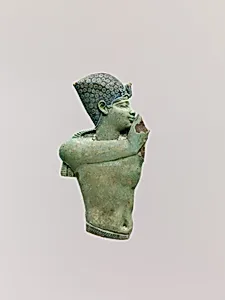
Medium
Faience
Dimensions
H. 10.8 cm (4 1/4 in.); W. 5.6 cm (2 3/16 in.); D. 1.3 cm (1/2 in.)
Classification
Inlay, upper part of a king
Period
Late Period–Ptolemaic Period
Department
Egyptian Art
Museum
Metropolitan Museum of Art, New York, NY
Credit
Purchase, Edward S. Harkness Gift, 1926
Accession Number
26.7.1006
Rights
Public Domain
Tags
Art Historical Context
This delicate faience inlay captures the upper torso of an Egyptian king, his arms raised in a classic of adoration or offering to the gods. Crafted between 400–200 B.C. during the Late Period to early Ptolemaic era, it measures just 10.8 cm high, suggesting it once adorned a larger statue, pectoral, or piece of furniture in a temple or royal setting. Faience, a glazed composite of quartz paste fired to a brilliant turquoise hue, was prized in ancient Egypt for its luminous, jewel-like quality, evoking the eternal blue of the Nile and the heavens. The king's idealized form reflects enduring Egyptian conventions of divine kingship, even as Ptolemaic rulers—Greek descendants of Alexander the Great—adopted pharaonic imagery to legitimize their rule. This small artifact highlights the continuity of tradition amid cultural shifts, with the raised arms symbolizing piety and cosmic harmony. Faience inlays like this were technically sophisticated, involving precise molding and glazing techniques that ensured vibrant color and durability. Acquired through the Edward S. Harkness Gift in 1926, this piece now graces the Metropolitan Museum of Art's Egyptian Art collection, offering visitors a glimpse into the sacred world of pharaohs and their eternal devotion.