
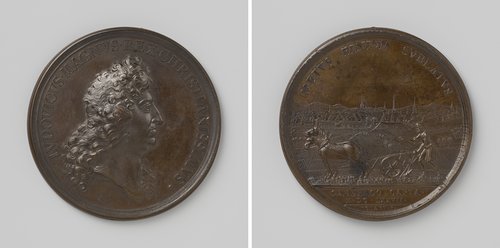
Inname van Kamerijk door de Fransen
1677
Medium
striking (metalworking)
Dimensions
7.3; 136.62
Rights
Public Domain
About this artwork
Gift of J.M. van Gelder-Nijhoff
Art Historical Context
### Inname van Kamerijk door Fransen This striking medallic artwork, created by Jérôme Roussel in 1677, commemorates a pivotal moment in the Franco-Dutch War: French capture of Cambrai, a city in the Spanish Netherlands. Under King Louis XIV's ambitious expansion, French forces besieged and seized the city that year, marking a strategic victory that bolstered France's northern frontiers. Measuring just 7.3 cm in diameter and weighing 136.62 grams, this substantial silver or base metal piece served as both a historical record and a tool of royal propaganda, celebrating military triumph in a portable, elegant form. Crafted through the "striking" technique—a precise metalworking method where a hardened steel die is hammered into a blank disc to produce high-relief imagery—Roussel's medal exemplifies 17th-century Baroque medallic art. This process allowed for intricate details, likely including portraits of Louis XIV, allegorical figures of victory, and city views, capturing the era's grandeur and drama. Medals like this were prized collectibles among Europe's elite, blending artistry with political messaging. Generously donated by J.M. van Gelder-Nijhoff, this piece invites us to reflect on how art immortalizes conquests, offering a tangible glimpse into the rivalries that shaped modern Europe. A testament to Roussel's skill, it reminds visitors of the medal's role as a "pocket monument" in an age of absolutist glory. *(198 words)*