
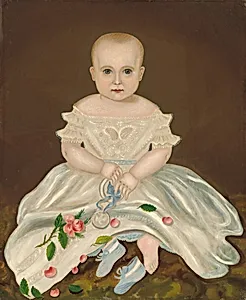
Innocence
c. 1830
Medium
oil on canvas
Dimensions
overall: 68.9 x 56.5 cm (27 1/8 x 22 1/4 in.) framed: 82.1 x 69.4 x 3.5 cm (32 5/16 x 27 5/16 x 1 3/8 in.)
Classification
Painting
Department
CAB
Museum
National Gallery of Art, Washington, D.C.
Credit
Gift of Edgar William and Bernice Chrysler Garbisch
Accession Number
1980.62.30
Rights
Public Domain
Art Historical Context
**Innocence**, an evocative oil on canvas painting from around 1830, captures the essence of early 19th-century American. Created by an anonymous artist, this work measures 68.9 x 56.5 cm, a modest scale typical for intimate portraits or genre scenes of the period. The title *Innocence* suggests a tender portrayal, likely evoking childhood purity—a common theme in American folk painting, where everyday virtues were celebrated amid the young nation's growing cultural identity. Oil on canvas was a favored medium in the early 1800s, allowing artists to achieve luminous skin tones, soft fabrics, and detailed backgrounds that brought subjects to life. Though the specific artist remains unknown, the piece reflects the self-taught, heartfelt style of 19th-century American painters, often from rural or itinerant traditions. Its presence in the National Gallery of Art's collection, thanks to the generous gift of Edgar William and Bernice Chrysler Garbisch—renowned collectors of American folk art—highlights its enduring appeal and historical value. This charming work invites visitors to ponder the simplicity and optimism of antebellum America, where art served as both personal memento and moral emblem. Framed at 82.1 x 69.4 x 3.5 cm, it stands as a window into a time when innocence symbolized hope for the future.
About the Artist
American 19th Century · 1800–1900
The artist cataloged as "American, 19th Century" represents a collective of unidentified painters active in the United States during the nineteenth century, with 380 known artworks preserved in this virtual museum's collection. These works span a diverse array of genres typical of the era, including portraits, landscapes, still lifes, and genre scenes, reflecting the burgeoning artistic output of ...