
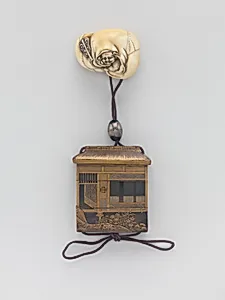
家屋形蒔絵印籠|Inrō in the Shape of a House
Unknown Artist
late 18th–early 19th century
Medium
Two cases; lacquered wood with gold and silver takamaki-e, hiramaki-e, togidashimaki-e, cutout gold foil application on black lacquer ground Netsuke: ivory; Hotei in a bag Ojime: metal bead
Dimensions
Inro: H. 2 1/4 in. (5.7 cm); W. 1 7/8 in. (4.8 cm); D. 9/16 in. (1.5 cm)) Netsuke: H. 1 in. (2.5 cm); W. 1 3/4 in. (4.4 cm); D. 1 1/4 in. (3.2 cm)
Classification
Inrō
Culture & Period
Japan · Edo period (1615–1868)
Department
Asian Art
Museum
Metropolitan Museum of Art, New York, NY
Credit
H. O. Havemeyer Collection, Bequest of Mrs. H. O. Havemeyer, 1929
Accession Number
29.100.841
Rights
Public Domain
Tags
Art Historical Context
This delightful *Inrō in the Shape of a House from Japan's Edo period (late 18th–early 19th century) exemplifies the exquisite craftsmanship of lacquerware during a time when these portable boxes were essential accessories for men. Worn suspended from the kimono sash via a silk cord, an *inrō* consisted of stacked compartments for carrying medicines, seals, or tobacco—practical yet stylish, as kimonos lacked pockets. Its whimsical house form, complete with roof and walls, adds a playful touch, transforming a utilitarian object into wearable art. Crafted from lacquered wood on a black ground, the *inrō* showcases advanced *maki-e* techniques: raised (*takamaki-e*), flat (*hiramaki-e*), and polished (*togidashimaki-e*) gold and silver powders, plus intricate cutout gold foil, creating a shimmering, three-dimensional effect evoking lantern-lit homes. The ensemble includes an ivory *netsuke*—a carved toggle depicting Hotei, the jovial god of fortune clutching his treasure bag—and a metal *ojime* bead to cinch the cord. At just over 2 inches tall, its compact size (H. 2¼ in.) highlights the miniaturist's skill. A highlight of the Metropolitan Museum of Art's Asian Art collection from the H.O. Havemeyer bequest, this *inrō* reflects Edo Japan's thriving merchant culture, where such opulent items symbolized status and good fortune. Visitors, imagine slipping it onto your own sash for a touch of historical elegance!