
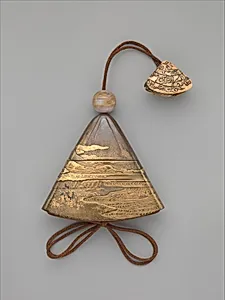
冨士形蒔絵印籠|Inrō in the Shape of Mount Fuji with a Crossing Ferry and Procession
late 18th–early 19th century
Medium
Two cases; lacquered wood with gold and silver takamaki-e, hiramaki-e, togidashimaki-e, cut-out gold foil on nashiji lacquer ground Netsuke: ivory; Ryūgūjō (The Dragon King's undersea palace) in a clam Ojime: agate bead
Dimensions
4 1/8 x 4 11/16 x 1 1/4 in. (10.5 x 11.9 x 3.2 cm)
Classification
Inrō
Culture & Period
Japan · Edo period (1615–1868)
Department
Asian Art
Museum
Metropolitan Museum of Art, New York, NY
Credit
Rogers Fund, 1913
Accession Number
13.67.93
Rights
Public Domain
Tags
Art Historical Context
This exquisite *Inrō in the Shape of Mount Fuji a Crossing Ferry and Process*, from Japan's Edo period (late 18th–early 19th century), exemplifies the refined artistry of lacquerware masters attributed to Hanabusachō and the Kajikawa workshop. Shaped like the iconic Mount Fuji, the two-case inrō depicts a lively ferry crossing with a procession, evoking the bustling travel and reverence for Japan's sacred peak during a time of relative peace and cultural flourishing. Crafted from lacquered wood, it masterful maki-e techniques: gold and silver *takamaki-e* (raised sprinkled lacquer) for dimension, *hiramaki-e* (flat sprinkled) for smooth elegance, *togidashimaki-e* (burnished) for subtle sheen, and cut-out gold foil over a shimmering *nashiji* (pear-skin) ground. The ensemble is completed by an ivory netsuke carving of Ryūgūjō—the Dragon King's mythical undersea palace—nestled in a clam, and an agate bead ojime, all securing the cord worn from a kimono sash. Inrō like this were status symbols for Edo-era gentlemen, holding medicines or seals while displaying exquisite craftsmanship. Acquired through the Rogers Fund in 1913 for the Metropolitan Museum of Art, this piece highlights Japan's fusion of nature, mythology, and technical virtuosity in Asian Art.
About the Artist
Hanabusa Itchō|Kajikawa · 1652–1724
Japanese, 1652–1724