
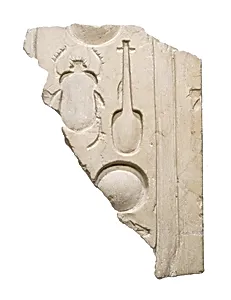
Inscribed element, Akhenaten
Unknown Artist
ca. 1353–1336 B.C.
Medium
Indurated limestone
Dimensions
H. 16.2 × W. 11.2 × D. 6 cm (6 3/8 × 4 7/16 × 2 3/8 in.); sides and thickness narrow toward top;on back at about 6 cm in is a raised edge
Classification
Inscribed element, Akhenaten cartouche
Period
New Kingdom, Amarna Period
Department
Egyptian Art
Museum
Metropolitan Museum of Art, New York, NY
Credit
Gift of Edward S. Harkness, 1921
Accession Number
21.9.595
Rights
Public Domain
Tags
Art Historical Context
This petite inscribed element from the reign of Akhenaten (ca. 1353–1336 B.C.) offers a tangible glimpse into one of ancient Egypt's most revolutionary eras Crafted during Dynasty 18's New Kingdom, specifically the Amarna Period, hails from the court of the pharaoh who upended tradition by promoting the sun disk Aten as the supreme deity. Likely a fragment of a larger architectural or ritual object—perhaps a pedestal or altar base—its indurated limestone medium was prized for its durability and fine carving quality, allowing precise hieroglyphic inscriptions. The object's tapering form, narrowing toward the top with a raised edge on the back, reflects Amarna artistry's innovative naturalism and elongation, departing from rigid Old Kingdom ideals. Hieroglyphs etched upon it probably invoke Akhenaten's royal names or divine epithets, underscoring his cult's propaganda. Such pieces were essential in temples and palaces, ritually activating spaces with the pharaoh's eternal presence. A gift to the Metropolitan Museum of Art in 1921, this 16.2 cm tall relic survives the Amarna Period's iconoclastic backlash, when successors like Tutankhamun erased Akhenaten's legacy. It invites us to ponder a pharaoh's bold vision amid Egypt's sun-baked sands.