
Inscribed stele
Unknown Artist
7th–9th century
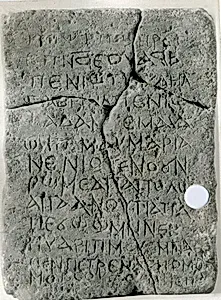
Medium
Limestone; incised
Dimensions
H. 11 7/16 in. (29 cm) W. 8 1/4 in. (21 cm) D. 2 7/8 in. (7.3 cm)
Classification
Sculpture
Department
Islamic Art
Museum
Metropolitan Museum of Art, New York, NY
Credit
Gift of The Egyptian Research Account and British School of Archaeology in Egypt, 1908
Accession Number
08.205.10d
Rights
Public Domain
Art Historical Context
This inscribed stele, carved from limestone in the 7th–9th century, stands as a poignant artifact from early Islamic Egypt. Measuring just 11½ inches tall, it exemplifies compact yet monumental stone sculpture, likely serving as a gravestone or marker. The incised inscriptions—precisely carved lines etched into the surface—would have conveyed religious texts, epitaphs, or invocations, reflecting the era's burgeoning Islamic epigraphy during the Umayyad and early Abbasid periods. Artistically, the technique of incising allowed for durable, legible script on a portable scale, highlighting the skill of anonymous masons who balanced functionality with subtle aesthetic elegance. Such stelae were common in Egyptian cemeteries, blending pre-Islamic traditions with emerging Islamic motifs and Kufic-style lettering, underscoring cultural continuity amid religious transformation. Donated to the Metropolitan Museum of Art in 1908 by the Egyptian Research Account and British School of Archaeology in Egypt, this piece offers visitors a tangible link to daily spiritual life in medieval Islamic society, inviting reflection on how stone preserved memory across centuries.