
Insertion
Unknown Artist
16th century
Medium
Bobbin lace
Dimensions
L. 10 x W. 1 3/4 inches (25.4 x 4.4 cm)
Classification
Textiles-Laces
Culture
Italian
Department
European Sculpture and Decorative Arts
Museum
Metropolitan Museum of Art, New York, NY
Credit
The Nuttall Collection, Gift of Mrs. Magdalena Nuttall, 1908
Accession Number
08.180.524
Rights
Public Domain
Art Historical Context
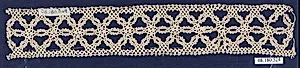
Step into the intricate world of Renaissance lace-making with *Insertion*, a delicate 16th-century bob lace strip from Italy, now housed in the Metropolitan Museum Art's European Sculpture andative Arts collection. Measuring just 10 by 1 3/4 inches (25.4 x 4.4 cm), this narrow band exemplifies the exquisite craftsmanship of Italian textile artists, though the creator remains unknown. As part of The Nuttall Collection, gifted by Mrs. Magdalenauttall in 1908, it highlights the era's fusion of artistry and utility. Bobbin lace, a technique pioneered in Italy and Flanders during the 16th century, involved skilled lacemakers twisting and intertwining fine linen threads held on handheld bobbins over a pricked paper pattern. This method allowed for complex geometric motifs and floral designs, far more precise than needle lace. *Insertion* lace like this was prized for its versatility—sewn between fabric edges to embellish collars, cuffs, altar cloths, or household linens—symbolizing wealth and refinement among Europe's nobility. In the Renaissance, Italian lace became a cultural export, influencing fashion across continents and elevating textiles to high art. This piece captures that legacy, offering a tactile glimpse into the labor-intensive patience of anonymous artisans whose work adorned the elite. A testament to enduring elegance!