
Insertion
Unknown Artist
17th century
Medium
Bobbin lace
Dimensions
L. 9 x W. 1 1/2 inches (22.9 x 3.8 cm)
Classification
Textiles-Laces
Culture
Italian, Rome
Department
European Sculpture and Decorative Arts
Museum
Metropolitan Museum of Art, New York, NY
Credit
The Nuttall Collection, Gift of Mrs. Magdalena Nuttall, 1908
Accession Number
08.180.528
Rights
Public Domain
Art Historical Context
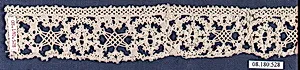
Nestled in the Metropolitan Museum of Art's European Sculpture and Decorative collection, *Insertion* a delicate 17th bobbin lace panel from Rome, Italy. Measuring just 9 by 1½ inches (22.9 x 3.8 cm), this strip exemplifies the exquisite needlework traditions of Baroque-era Italy. Created by an unknown artist, it was generously gifted in 1908 as part of The Nuttall Collection by Mrs Magdalena Nuttall, the era's passion for intricate textiles. Bobbin lace, known as *merletto a fuselli* in Italy, involves twisting and intertwining fine threads held on small bobbins over a patterned pillow—a labor-intensive technique that allowed for complex, geometric motifs and floral designs. In 17th-century Rome, lace like this was a status symbol, adorning ecclesiastical vestments, elite garments, and household linens. Insertions such as this one were ingeniously sewn into seams or edges of fabric, transforming everyday items into opulent displays of craftsmanship. This piece offers a window into Italy's golden age of lace-making, where convents and workshops rivaled painting and sculpture in prestige. Its preservation underscores the cultural reverence for *arti femminili* (women's arts), blending utility with artistry in a fragile yet enduring form.