
Insertion
Unknown Artist
16th century
Medium
Cutwork
Dimensions
4 5/8 × 7 in. (11.7 × 17.8 cm)
Classification
Textiles-Laces
Culture
Italian
Department
European Sculpture and Decorative Arts
Museum
Metropolitan Museum of Art, New York, NY
Credit
Gift of Marian Hague, 1938
Accession Number
38.185.25
Rights
Public Domain
Art Historical Context
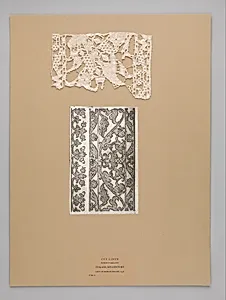
Step into the intricate world of Renaissance lace with *Insertion*, a delicate 16th-century Italian textile the Metropolitan Museum of Art European Sculpture and Decorative collection. Measuring just 4 5/8 × 7 inches, this exquisite piece—generously gifted by Marian Hague in 1938 crafted by an unknown artist using cutwork, a prized technique that transformed linen into airy, ornamental patterns. Cutwork, or *punto tagliato in Italian, involved meticulously cutting away sections of fabric and securing the edges with precise needlework embroidery. Popular in Renaissance Italy, especially in lace-making hubs like Venice, this method bridged embroidery and true lace, creating geometric motifs that mimicked the era's architectural elegance. Its small scale suggests it was designed as an "insertion"—a decorative strip sewn into garments, collars, or household linens to elevate everyday items into displays of sophistication. In 16th-century Europe, such laces symbolized wealth and refinement, adorning the elite from nobility to clergy. *Insertion* exemplifies the anonymous mastery of Italian artisans, whose innovations laid the groundwork for lacemaking's golden age, inviting us to marvel at the patience and skill behind these fragile treasures.