
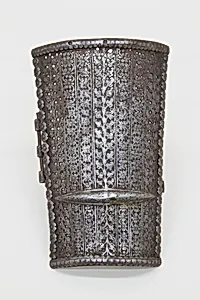
Inside Lame of Arm Guard
Unknown Artist
17th century
Medium
Steel
Dimensions
H. 7 1/8 in. (18.1 cm); W. 4 1/2 in. (11.4 cm); D. 1 7/16 in. (3.7 cm); Wt. 8.2 oz. (232 g)
Classification
Armor Parts
Culture
Indian
Department
Arms and Armor
Museum
Metropolitan Museum of Art, New York, NY
Credit
Bequest of George C. Stone, 1935
Accession Number
36.25.404
Rights
Public Domain
Art Historical Context
This delicate steel lame, or articulated plate, forms the inner layer of an arm guard from 17th-century India, a time when the Mughal Empire dominated the subcontinent. Measuring just 7⅛ inches high and weighing a mere 8.2 ounces, it exemplifies the precision engineering of Indian armorers, who crafted protective gear for elite warriors on horseback. Part of a larger suit, this component would have overlapped with outer lames and chainmail (chain), allowing fluid arm movement during battle while deflecting blows from swords and arrows. Forged from high-quality steel, the lame highlights advanced metallurgical techniques honed in Indian workshops, where repeated folding and hammering created resilient yet lightweight plates. Riveted edges ensured seamless articulation, balancing defense with agility—crucial in the dynamic warfare of the Mughal era, from imperial campaigns to Rajput skirmishes. Though unadorned on its interior side, such pieces often paired with lavishly etched or gilded exteriors, blending utility with the opulence of South Asian arms. Today, this artifact from the Metropolitan Museum of Art's Arms and Armor collection, bequeathed by George C. Stone in 1935, offers a tactile glimpse into India's martial heritage, reminding us how craftsmanship turned raw metal into lifesaving art.