
Insignia and Button
Unknown Artist
late 19th century
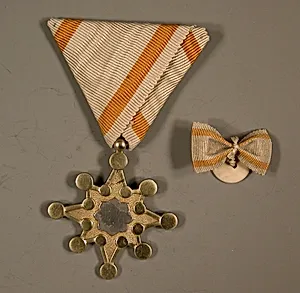
Medium
White triangular ribbon with yellow stripes
Dimensions
a: 3 × 1 1/2 in. (7.6 × 3.8 cm) b: 1/2 × 1 in. (1.3 × 2.5 cm)
Classification
Medals
Culture & Period
Japan · Meiji period (1868–1912)
Department
Asian Art
Museum
Metropolitan Museum of Art, New York, NY
Credit
Gift of Edward D. Adams and Jacob H. Schiff, 1906
Accession Number
06.442a, b
Rights
Public Domain
Art Historical Context
This delicate insignia and button from late 19th-century Japan the refined craftsmanship of the Meiji period (1868–1912), a transformative era when the nation modernized rapidly while blending traditional aesthetics with Western influences. Crafted as a medal, the piece consists of a white triangular ribbon accented by crisp yellow stripes (3 × 1½ in. or 7.6 × 3.8 cm) paired with a small button (½ × 1 in. or 1.3 × .5 cm). Such were often worn as symbols of rank, achievement, or affiliation, reflecting Japan's evolving military and imperial structures amid global expansion. The simplicity of the medium—silk or satin ribbon dyed in symbolic colors—highlights Meiji artisans' mastery of subtle design, where form conveyed status without ostentation. White evoked purity and loyalty, while yellow stripes may denote a specific order or unit, underscoring the period's emphasis on disciplined hierarchy. Acquired as a gift from collectors Edward D. Adams and Jacob H. Schiff in 1906, this artifact now resides in The Metropolitan Museum of Art's Asian Art Department, offering visitors a tangible link to Japan's ambitious rebirth. (198 words)