
Insignia, Medal and Button
Unknown Artist
late 19th century
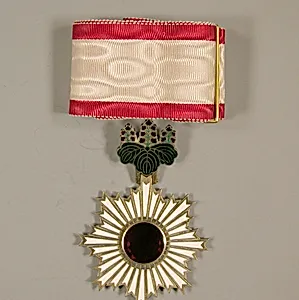
Medium
Silver; white ribbon with red borders
Dimensions
a: 4 5/8 × 2 1/4 in. (11.7 × 5.7 cm) b: 3 5/8 × 3 1/2 × 1/2 in. (9.2 × 8.9 × 1.3 cm) c: 1/2 × 7/16 in. (1.3 × 1.1 cm)
Classification
Medals
Culture & Period
Japan · Meiji period (1868–1912)
Department
Asian Art
Museum
Metropolitan Museum of Art, New York, NY
Credit
Gift of Edward D. Adams and Jacob H. Schiff, 1906
Accession Number
06.427a–c
Rights
Public Domain
Art Historical Context
This exquisite set of *Insignia, Medal and Button* from late 19th-century Japan a glimpse into the Me period (1868–1912), a transformative era when the nation rapidly modernized while preserving its imperial traditions. Crafted in silver with a white ribbon accented by red borders, items—measuring a compact 4 5/8 × 2 1/4 inches for the insignia, slightly larger for the medal, a petite button—likely served as official decorations, possibly for military or court officials. The Meiji era saw Japan emulate Western honors systems to symbolize national strength and loyalty to the emperor, blending intricate Japanese metalworking with emerging symbols of statehood. The silver medium highlights masterful Japanese craftsmanship, where artisans employed repoussé techniques or fine chasing to create detailed emblems, evoking prestige and hierarchy. Red borders on the ribbon nod to auspicious colors in Japanese culture, often linked to imperial authority. Donated to the Metropolitan Museum of Art in 1906 by collectors Edward D. Adams and Jacob H. Schiff, this piece reflects early 20th-century fascination with Japan's ascent as a global power. Today, it invites visitors to ponder how everyday regalia encapsulated Japan's bold pivot from isolation to empire, a testament to cultural resilience amid change.