
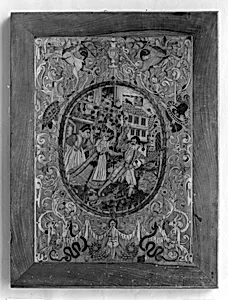
Intarsia panel
Unknown Artist
late 16th century
Medium
Various intarsia woods partly stained red and green
Dimensions
24 3/4 × 17 3/4 in. (62.9 × 45.1 cm)
Classification
Woodwork
Culture
German
Department
European Sculpture and Decorative Arts
Museum
Metropolitan Museum of Art, New York, NY
Credit
Rogers Fund, 1912
Accession Number
12.145
Rights
Public Domain
Tags
Art Historical Context
This exquisite intarsia panel, by an unknown German artist in the late 16th, showcases the pinnacle of Renaissance woodworking from Southern Germany. Measuring 24¾ × 17¾ inches, it features intricate scenes of men and women rendered in various woods, with selective staining in red and green enhance depth and vibrancy. Acquired by The Metropolitan Museum of Art through Rogers Fund in 191, it resides in the European Sculpture andative Arts collection, highlighting Germany's mastery of decorative woodwork during a time when such panels adorned choir stalls, studioli (private studies), and palace interiors. Intarsia, a technique akin to mosaic-making in wood, involves precisely cutting and fitting differently colored woods to create illusionistic, three-dimensional images—here evoking lifelike figures against imagined backgrounds. The partial staining mimics costly pigments, allowing artisans to achieve painterly effects without paint, a clever innovation that democratized opulence in ecclesiastical and secular settings. This panel exemplifies the Northern Renaissance's fusion of Italian perspective techniques with Germanic precision, reflecting the era's booming trade in exotic woods and the rise of humanist themes in everyday luxury. Visitors will appreciate how this surviving gem captures the tactile magic of intarsia: run your eye across it, and the woods seem to undulate, figures to emerge from shadow. A testament to anonymous craftsmanship, it invites us to ponder the skilled hands behind 16th-century splendor. (218 words)