
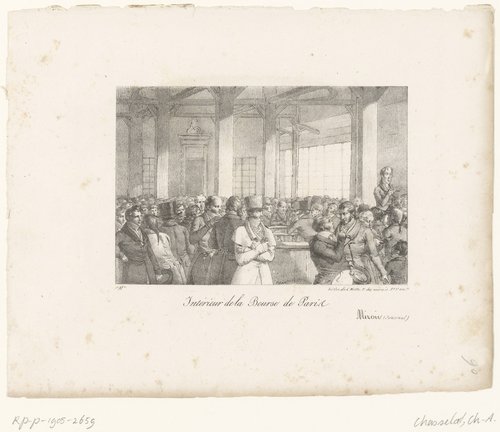
Intérieur de la Bourse de Paris
1820 - 1833
Medium
lithography
Dimensions
263; 213
Rights
Public Domain
About this artwork
height 213 mm x width 263 mm
Art Historical Context
Step into the bustling heart of 19th-century Paris with *Intérieur de la B de Paris* (Interior of the Paris Stock Exchange), captivating lithography by Charles-Abraham Chelat, created between 1820 and1833. Measuring a modest 213 mm high by 263 mm wide, this print offers a precise glimpse into one of Europe's emerging financial powerhouses. Chasselat, a French lithographer, specialized in architectural interiors, capturing the grandeur of public spaces with meticulous detail. Lithography, a revolutionary printing technique pioneered just two decades earlier, allowed Chasselat to reproduce intricate line work and subtle tones directly from a prepared stone—ideal for documenting neoclassical interiors like the Bourse, designed by Alexandre-Théodore Brongniart and opened in 1826. This medium democratized art, making high-fidelity views accessible beyond elite circles and preserving a snapshot of Paris during the Restoration and early July Monarchy eras. The artwork's cultural significance lies in its portrayal of the Bourse as a symbol of France's post-Revolutionary economic revival, where traders and investors gathered amid soaring columns and expansive vaults. For visitors today, it evokes the era's blend of opulence and ambition, reminding us how such prints chronicled the modernizing cityscape.