
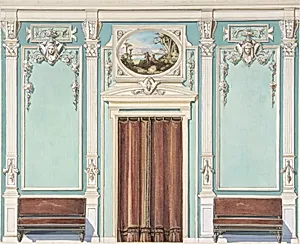
Interior Design with a Central Door with Brown Curtains Flanked by Benches, against an Aquamarine Wall, with an Overdoor Painting
late 19th century (?)
Medium
Gouache
Dimensions
sheet: 10 x 12 in. (25.4 x 30.5 cm)
Classification
Drawings|Ornament & Architecture
Department
Drawings and Prints
Museum
Metropolitan Museum of Art, New York, NY
Credit
Purchase, Anne and Carl Stern Fund, 1971
Accession Number
1971.605.7
Rights
Public Domain
Tags
Art Historical Context
This delicate gouache drawing, created by an anonymous British artist in the late 19 century, captures an elegant interior design centered on a symmetrical doorway. Flanked by sturdy benches and draped with rich brown curtains, the composition unfolds against a striking aquamarine wall, topped by an overdoor painting Measuring just 10 by 12 inches, the work exemplifies the precision of Victorian-era ornament and architecture sketches, likely intended as a proposal for a domestic or institutional space. Gouache, an opaque watercolor medium favored for its vibrant opacity and fine detail, allowed the artist to render textures—from the plush folds of the curtains to the subtle sheen of the wall—with remarkable clarity. Classified within the Metropolitan Museum of Art's Drawings and Prints department, this piece reflects Britain's 19th-century fascination with harmonious interiors, blending functionality with decorative flair. The cool aquamarine hue evokes emerging tastes for lighter, more refreshing palettes amid the era's ornate Aesthetic Movement influences. Acquired in 1971 through the Anne and Carl Stern Fund, this anonymous gem offers a window into everyday design aspirations of the time. Visitors, take a moment to admire how simple elements like benches and curtains create balanced symmetry, a timeless principle of British interior artistry.
About the Artist
Anonymous, British, 19th century · 1800–1900
**Anonymous, British, 19th century** is not the name of a single individual but a standard museum attribution used for works whose creators remain unidentified yet are clearly British and date to the 1800s. Major institutions, including the Metropolitan Museum of Art, employ this designation for hundreds of drawings, prints, designs, and decorative studies that lack signatures or firm documentary ...