
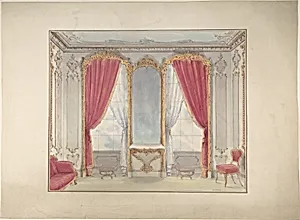
Interior of a Small Salon
mid-19th century
Medium
Pen and gray ink, watercolor, over graphite
Dimensions
11 7/16 x 15 5/8 in. (29.0 x 39.7 cm)
Classification
Drawings|Ornament & Architecture
Department
Drawings and Prints
Museum
Metropolitan Museum of Art, New York, NY
Credit
Dodge and Fletcher Funds, 1967
Accession Number
67.736.57
Rights
Public Domain
Tags
Art Historical Context
Step into the intimate world of 19th-century French domestic life with *Interior of a Small Salon* by Simon-Claude Constant-Dufe, a mid-19th-century architectural drawing now housed in the Metropolitan Museum of Art's Drawings and Prints department. Created during a time when France's bourgeoisie embraced eclectic Revival styles amid rapid urbanization, this work captures the refined elegance of a private salon—a cozy social space for conversation and leisure. Constant-Dufeux, a French architect known for his ornamental designs and restorations, masterfully renders the room's harmonious blend of architecture, furniture, and decorative elements, evoking the era's fascination with historicism and comfort. Executed in pen and gray ink with watercolor over graphite on a modest 11 7/16 x 15 5/8-inch sheet, piece exemplifies the precision of 19th-century architectural drafting. Graphite underdrawing provides subtle structural guidelines, while fine pen lines delineate intricate details like windows, flowing curtains, ornate furniture, and gleaming mirrors—hallmarks of bourgeois taste. The grayscale watercolor adds depth and atmospheric perspective, mimicking the soft light filtering through those windows, a technique that brings the static interior to life. This drawing not only showcases Constant-Dufeux's technical virtuosity but also offers a window into mid-19th-century cultural values: the salon as a microcosm of sophistication, where mirrors amplified light and space in compact urban homes. A gem for architecture enthusiasts, it highlights how drawings like this preserved and inspired the decorative arts of the Belle Époque's precursors.