
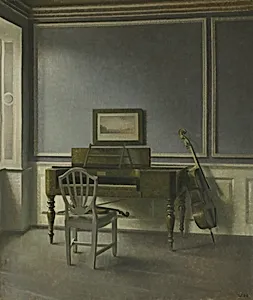
Interior. The Music Room, Strandgade 30
Medium
Oil on canvas
Dimensions
70 × 59 cm (27 9/16 × 23 1/4 in.); Framed: 85.4 × 75.2 × 7.6 cm (33 5/8 × 29 5/8 × 3 in.)
Classification
painting
Department
Painting and Sculpture of Europe
Museum
Art Institute of Chicago
Accession Number
270002
Rights
Public Domain
About this artwork
On September 15, 1898, Vilhelm Hammershøi and his wife Ida moved to an apartment on the upper floor of Strandgade 30 in Copenhagen, where they remained until 1909. This stay coincided with the most productive period of the artist’s career, during which he painted his best-known series of works: ever-evolving variations on the interior of his apartment. Hammershøi regularly depicted this corner of his drawing room, both with and without the figure of Ida. For the artist, the apartment was akin to...
Art Historical Context
In this oil painting, a softly lit room unfolds in muted tones of gray, beige, and pale blue. A dark upright piano stands against the wall beneath a small framed landscape, while a cello leans casually against its side. A simple wooden chair sits in the foreground, angled as if recently used, with a violin resting on its seat. Light enters from the left, casting gentle shadows across the paneled walls and wooden floor, emphasizing the quiet emptiness of the space. Vilhelm Hammershøi painted *Interior. The Music Room, Strandgade 30* in 1907, capturing the restrained elegance of his own Copenhagen apartment. The Danish artist was celebrated for his poetic interiors that focus on light, stillness, and subtle geometry rather than narrative or figures. Here, musical instruments suggest recent activity without showing anyone present, inviting viewers to sense the room’s calm atmosphere. Hammershøi’s restrained palette and meticulous attention to daylight made his work distinctive within early twentieth-century European painting. This canvas, now in the Art Institute of Chicago’s collection, exemplifies his ability to transform an ordinary domestic setting into a meditative study of space and silence.