
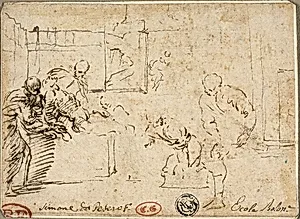
Interior with Male Nude Surrounded by Five Figures
n.d.
Medium
Pen and brown ink, with traces of black chalk, on ivory laid paper, laid down on ivory laid paper, tipped onto gray-green laid paper
Dimensions
9.3 × 12.7 cm (3 11/16 × 5 in.)
Classification
pen and ink drawings
Department
Prints and Drawings
Museum
Art Institute of Chicago
Accession Number
112797
Rights
Public Domain
Art Historical Context
Simone Cantarini's *Interior with Male Nude Sur by Five Figures* is a captivating preparatory drawing from the Italian Baroque era, showcasing the artist's mastery of the human form. Born in 1612 in Pesaro, Cantarini trained under Guercino and was influenced by the Carracci emphasis on dynamic composition and naturalism. Active in Bologna and Rome until his early death in 1648, he produced elegant drawings like this one, often as studies for paintings or etchings. The undated work, executed in pen and brown ink with subtle traces of black chalk on ivory laid paper, measures a intimate 9.3 × 12.7 cm, inviting close inspection. The scene depicts a central male nude in an interior setting, encircled by five figures—likely contemporaries or students in a studio atmosphere—highlighting Cantarini's focus on anatomical precision and spatial arrangement. Brown ink lines provide fluid, expressive contours and hatching for depth, while faint black chalk underdrawing reveals his methodical process: sketching forms before refining with ink. This technique, common in 17th-century Italian workshops, allowed artists to explore ideas rapidly on affordable laid paper. Housed in the Art Institute of Chicago's Prints and Drawings collection, this gem underscores the Baroque fascination with movement and realism in private studies. It offers visitors a window into the creative workshop, where nudes served as foundational exercises, bridging classical ideals with emerging naturalism.
About the Artist
Simone Cantarini · 1612–1648
He was one of the most eminent pupils of Guido Reni and one of the most gifted engravers in the tradition of the Carracci. He had a strong personality and developed a highly original style, which united aspects of Bolognese classicism with a bold naturalism. Comment on works: Religious