
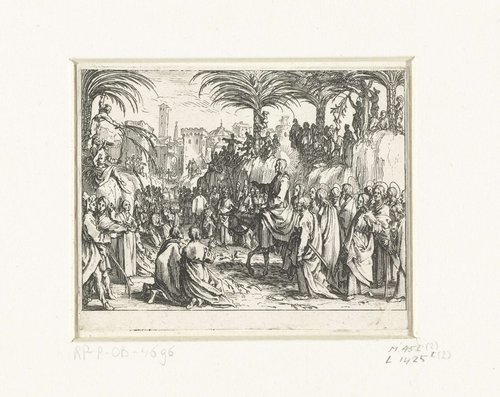
Intocht in Jerusalem
1635
Medium
etching
Dimensions
87; 69
Rights
Public Domain
About this artwork
ets
Art Historical Context
Jacques Callot's *Intocht in Jerusalem* (Entry into Jerusalem), in 1635, captures the moment of Christ's triumphal arrival in a remarkably compact format—measuring just 69mm high by 87mm wide. As a master of the Baroque era, Callot, a French printmaker who worked extensively in Italy and for the Medici court, excelled in rendering grand narratives on intimate scales. This scene likely draws from his deep engagement with religious iconography, blending spiritual drama with meticulous detail. Etching, Callot's preferred medium, allowed for unprecedented precision through acid-bitten lines on copper plates, enabling intricate compositions that rival paintings in complexity. His innovative techniques, like multiple bitings for tonal depth and swelling lines for movement, populate the tiny surface with crowds, animals, and architecture, evoking the chaos and reverence of the Passion story. Produced amid Europe's Thirty Years' War, it reflects the era's fervor for devotional art amid turmoil. This petite print exemplifies Callot's genius for "small wonders," making sacred history accessible to collectors and the faithful, and remains a testament to etching's power as a democratic art form in the 17th century.
About the Artist
Jacques Callot · 1592–1635
Jacques Callot (1592–1635) was a French printmaker and draftsman from the Duchy of Lorraine, widely regarded as one of the first great artists to practice the graphic arts exclusively. His more than 1,400 etchings chronicled the breadth of 17th-century life, from Medici court festivities to the brutal realities of warfare. Callot revolutionized etching through technical innovations including the é...