
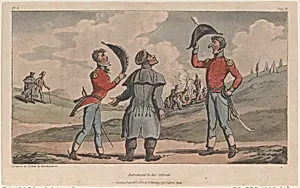
Introduced to his Colonel
Medium
Hand-colored etching and aquatint
Dimensions
Sheet: 4 15/16 × 7 15/16 in. (12.5 × 20.2 cm)
Classification
Prints
Department
Drawings and Prints
Museum
Metropolitan Museum of Art, New York, NY
Credit
The Elisha Whittelsey Collection, The Elisha Whittelsey Fund, 1959
Accession Number
59.533.1623(6)
Rights
Public Domain
Tags
Art Historical Context
**Introduced to his Colonel** (1815) by Thomas Rowlandson, with publication by Patrick Martin &, is a delightful hand-colored etching and aquat from the Metropolitan Museum of Art's Elisha Whittelsey Collection. Measuring just under 5 by 8 inches, this compact print exemplifies Rowlandson's signature satirical style, poking fun at British military life during the Napoleonic era's final days. The title evokes a comically awkward encounter between a soldier and his superior officer, highlighting the era's rigid hierarchies and human follies amid wartime pomp. Created in 1815—the year of Waterloo's triumph—this work reflects the cultural fervor and relief in Britain as Napoleon's defeat reshaped Europe. Rowlandson, a leading caricaturist of the Regency period, often lampooned soldiers and society, making his prints accessible commentary on everyday absurdities. The hand-coloring adds vibrant life to the etched lines, while aquatint's tonal washes create subtle shading, enhancing the expressive faces and dynamic poses typical of 19th-century British satire. These affordable prints circulated widely, democratizing humor and critique. A charming glimpse into post-war Britain, it invites visitors to chuckle at timeless military mishaps while appreciating Rowlandson's masterful blend of wit and technique.
About the Artist
Thomas Rowlandson|Patrick Martin & Co · 1756–1827
Thomas Rowlandson (1757–1827) was an English artist and caricaturist whose satirical watercolors and prints captured the social life of Georgian Britain with unparalleled wit and technical mastery. Alongside James Gillray, he is recognized as one of the greatest British graphic artists, and his distinctive flowing line and keen observations have made his work integral to understanding late 18th an...