
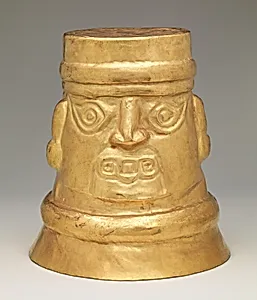
Inverse-Face Beaker
10th–11th century
Medium
Gold
Dimensions
H. 7 7/8 × Diam. 7 1/8 in. (20 × 18.1 cm)
Classification
Metal-Containers
Culture
Lambayeque (Sicán)
Department
Arts of Africa, Oceania, and the Americas
Museum
Metropolitan Museum of Art, New York, NY
Credit
Jan Mitchell and Sons Collection, Gift of Jan Mitchell, 1991
Accession Number
1991.419.60
Rights
Public Domain
Tags
Art Historical Context
This exquisite **Inverse-Face Beaker crafted by Lambayeque (Sicán) artists in the 10th–11th century, exemplifies the mastery of pre-Columbian goldsmithing from ancient Peru's northern coast. Standing at 7 7/8 inches tall a 7 1/8-inch diameter, this vessel from the Sicán culture—also known as Lambayeque—lights their reverence for gold, a sacred metal symbolizing the sun's divine power and elite status. Donated to the Metropolitan Museum of Art in 1991 as part of the Jan Mitchell Collection, it resides in the Arts of Africa, Oceania, and the Americas department. The beaker's striking design features an "inverse face," a hallmark of Sicán iconography where human or deity visages are rendered with inverted or symmetrical features, possibly evoking supernatural transformation or ritual duality. Fashioned through sophisticated techniques like hammering, repoussé, and chasing, the gleaming gold surface captures the culture's innovative metalwork, blending functionality as a ceremonial container with profound symbolic depth. Such beakers likely served in elite rituals, holding chicha (fermented maize beer) during feasts honoring ancestors or deities. In the Sicán worldview, art like this bridged the earthly and spiritual realms, reflecting a society flourishing after the Moche with advanced metallurgy and complex cosmology. Visitors, marvel at how this humble yet radiant object whispers tales of a lost Andean world!