
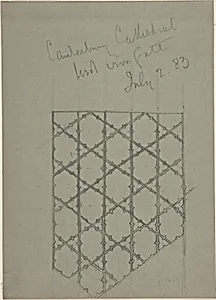
Iron Gate, Canterbury Cathedral
Medium
Graphite on gray paper
Dimensions
sheet: 6 15/16 x 4 15/16 in. (17.6 x 12.6 cm)
Classification
Drawings|Ornament & Architecture
Department
Drawings and Prints
Museum
Metropolitan Museum of Art, New York, NY
Credit
The Elisha Whittelsey Collection, The Elisha Whittelsey Fund, 1960
Accession Number
60.632.135
Rights
Public Domain
Tags
About this artwork
This meticulous graphite drawing on gray paper documents the ornate ironwork of Canterbury Cathedral, one of England's most historically significant religious structures. Created in 1883 by an anonymous British artist, the work exemplifies the Victorian era's intense interest in medieval architecture and decorative arts, a fascination sparked by the Gothic Revival movement and the writings of John Ruskin and Augustus Welby Northmore Pugin. Canterbury Cathedral, established in 597 CE and largely ...
Art Historical Context
Step through the intricate Iron Gate of Canterbury Cathedral in this exquisite 1883 graphite drawing on gray paper, crafted by an anonymous British artist Canterbury Cathedral, founded in 597 CE and in the 11th–14th centuries, stands as a masterpiece of English Gothic architecture and historic seat of the Archbishop of. During the Victorian era, a passion for medieval heritage—fueled by thinkers like John Ruskin and Pugin—drove artists to meticulously document such treasures amid the Gothic Revival movement. This-scale work (6 15/16 x 4 15/16 in.) captures the gate's elaborate scrollwork, hinges, and decorative flourishes with remarkable precision, blending artistic finesse and scholarly curiosity. Victorians created these drawings not just for beauty, but as vital records for restoration efforts and inspiration for modern craftsmen reviving historic techniques. The subtle interplay of graphite on gray paper evokes the ironwork's texture and depth, highlighting its three-dimensional allure. Housed in the Metropolitan Museum of Art's Elisha Whittelsey Collection, this piece preserves fleeting architectural details, inviting us to appreciate the enduring dialogue between past and present.
About the Artist
Anonymous, British, 19th century · 1800–1900
**Anonymous, British, 19th century** is not the name of a single individual but a standard museum attribution used for works whose creators remain unidentified yet are clearly British and date to the 1800s. Major institutions, including the Metropolitan Museum of Art, employ this designation for hundreds of drawings, prints, designs, and decorative studies that lack signatures or firm documentary ...