
"Iskandar in the Presence of the Brahmins", Folio from a Shahnama (Book of Kings) of Firdausi
ca. 1330–40
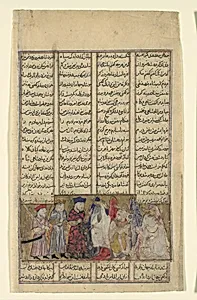
Medium
Ink, opaque watercolor, gold, and silver on paper
Dimensions
Page: H. 8 1/16 in. (20.5 cm) W. 4 7/8 in. (12.4 cm) Painting: H. 1 7/8 in. (4.7 cm) W. 4 5/16 in. (11 cm)
Classification
Codices
Department
Islamic Art
Museum
Metropolitan Museum of Art, New York, NY
Credit
Bequest of Monroe C. Gutman, 1974
Accession Number
1974.290.32
Rights
Public Domain
Tags
About this artwork
This codices titled ""Iskandar in the Presence of the Brahmins", Folio from a Shahnama (Book of Kings) of Firdausi" by Abu'l Qasim Firdausi dates to ca. 1330–40. Executed in ink, opaque watercolor, gold, and silver on paper, this work exemplifies the craftsmanship associated with Islamic Art. The piece demonstrates the technical skill and artistic vision characteristic of its period. The work's presence in a major museum collection attests to its significance in the broader narrative of art hist...
Art Historical Context
Step into the vibrant world of 14th-century Persian manuscript with this exquisite folio from Firdausi's *Shahnama* (Book of Kings), titledIskandar in the of the Brahmins."* Dating to around 1330–40, it captures a legendary episode where Iskandar— the Persian name for Alexander the Great—encounters wise Indian Brahmin philosophers. Firdausi's epic poem, completed in the early 11th century, chronicles Iran's mythical kings and heroes, blending history, legend, and moral tales. This scene highlights Iskandar's quest for wisdom, reflecting Persian admiration for the conqueror as a philosopher-king who bridges cultures from Greece to India. Crafted in ink, opaque watercolor, gold, and silver on paper, the miniature exemplifies the refined techniques of Islamic manuscript illumination from the Ilkhanid era. The small painting (just 1 7/8 x 4 5/16 inches) bursts with intricate details: luminous gold accents illuminate figures and architecture, while silver adds subtle sheen, creating a jewel-like glow. Opaque watercolors deliver bold, flat colors typical of Persian miniatures, prioritizing narrative clarity over realism in a codex format designed for intimate study. Housed in the Metropolitan Museum of Art's Islamic Art Department (Bequest of Monroe C. Gutman, 1974), this folio offers a window into medieval Persia's cultural synthesis—merging epic poetry, royal patronage, and artistic mastery. It invites visitors to ponder timeless themes of knowledge and encounter in one of the world's great literary traditions.
About the Artist
Abu'l Qasim Firdausi · 935–1020
Abu'l Qasim Firdausi, born around 940 in the village of Paj near Tus in Khorasan (modern-day Iran), emerged from a family of landed gentry known as dehqans, who preserved ancient Iranian oral traditions amid the cultural renaissance of the Samanid Empire. Little is documented about his early life or formal training, though he likely received a basic education including Arabic literacy, immersing h...