
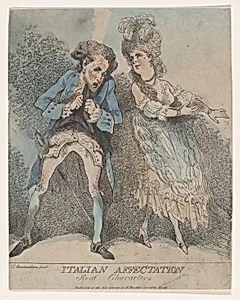
Italian Affectation, Real Characters
Medium
Hand-colored etching
Dimensions
Sheet: 9 3/16 × 7 1/4 in. (23.3 × 18.4 cm)
Classification
Prints
Department
Drawings and Prints
Museum
Metropolitan Museum of Art, New York, NY
Credit
The Elisha Whittelsey Collection, The Elisha Whittelsey Fund, 1959
Accession Number
59.533.9
Rights
Public Domain
Tags
Art Historical Context
"Italian Affectation, Real Characters" is a delightful hand-colored etching created between 1786 and 1791 by the renowned British caricaturist Thomas Rowlandson, in collaboration with Henry Brookes and Gaspare Pacchierotti. Measuring just 9 3/16 × 7 1/4 inches, this intimate print belongs to the Metropolitan Museum of Art's Elisha Whittelsey Collection. Rowlandson, a master of satirical illustration during the late 18th century, often lampooned social follies through exaggerated figures and sharp wit, aligning this work with the booming English caricature tradition. The title hints at its playful mockery of "Italian affectation," likely targeting the theatrical mannerisms of Italian singers—both men and women—performing in London's vibrant opera scene. Hand-coloring, applied by skilled artisans after printing, brings vivid life to the characters' flamboyant poses and costumes, enhancing the etching's humorous punch and making it a sought-after collector's item. This piece captures a cultural moment when Italian opera stars captivated British audiences, yet their perceived extravagance invited satire. Rowlandson's keen eye for human eccentricity underscores the era's blend of admiration and ridicule for foreign performers, offering visitors a window into Georgian London's lively social commentary.
About the Artist
Thomas Rowlandson|Henry Brookes|Gaspare Pacchierotti · 1756–1827
Thomas Rowlandson (1757–1827) was an English artist and caricaturist whose satirical watercolors and prints captured the social life of Georgian Britain with unparalleled wit and technical mastery. Alongside James Gillray, he is recognized as one of the greatest British graphic artists, and his distinctive flowing line and keen observations have made his work integral to understanding late 18th an...