
Italian Landscape
16th century
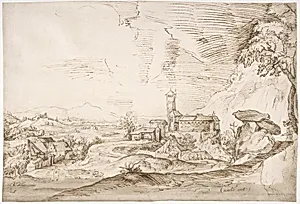
Medium
Pen and brown ink. Verso: red chalk
Dimensions
8 3/4 x 12 7/8 in. (22.3 x 32.7 cm)
Classification
Drawings
Department
Drawings and Prints
Museum
Metropolitan Museum of Art, New York, NY
Credit
Rogers Fund, 1950
Accession Number
50.72
Rights
Public Domain
Tags
Art Historical Context
Cornelis Cort's *Italian Landscape*, a 16th-century drawing the Metropolitan Museum of Art captures the serene beauty of the Italian countryside with houses nestled among trees. Created during the Renaissance era, when Northern European artists like the Dutch-born Cort (1536–8) traveled to Italy for inspiration, this work reflects his fascination with the region's topography. Cort, renowned as an engraver and draftsman, bridged Northern precision with Italianate grandeur, producing detailed studies that informed his influential prints. Executed in pen and brown ink on the recto, with red chalk sketches on the verso, the drawing showcases versatile techniques typical of preparatory sketches. The fine ink lines evoke depth and texture, highlighting Cort's mastery in rendering natural forms—undulating hills, sturdy trees, and humble dwellings—evident in the tags of houses, landscapes, and trees. Such dual-sided works were common in workshops, allowing artists to experiment before committing to engravings. Acquired through the Rogers Fund in 1950, this piece from the Met's Drawings and Prints department offers a window into 16th-century artistic exchange. It underscores how landscapes evolved from background elements to celebrated subjects, blending observation with imaginative idealization for patrons eager for souvenirs of Italy's allure.
About the Artist
Cornelis Cort · 1533–1578
Comment on works: copper engraver; engraver; etcher