
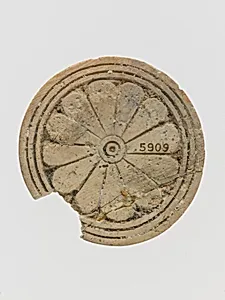
Ivory disk with rosette
Unknown Artist
ca. 1600–1050 BCE
Medium
Ivory
Dimensions
Diameter 2 in. (5.1 cm)
Classification
Miscellaneous-Bone, Ivory
Culture & Period
Cypriot · Late Bronze Age
Department
Greek and Roman Art
Museum
Metropolitan Museum of Art, New York, NY
Credit
The Cesnola Collection, Purchased by subscription, 1874–76
Accession Number
74.51.5220
Rights
Public Domain
Art Historical Context
This delicate ivory disk, adorned with a intricately carvedsette, hails from ancient Cyprus during the Late Bronze Ageca. 1600–1050 BCE). Measuring just 2 inches (5.1 cm) in diameter, it exemplifies the exquisite craftsmanship of Cypriot artisans who worked with imported elephant ivory—a rare and luxurious material traded across the eastern Mediterranean. The rosette motif, a floral or star-like pattern symbolizing beauty and perhaps fertility or celestial themes, was a popular decorative element in Cypriot art, on pottery, jewelry, seals. As a small, portable object classified under bone and ivory miscellanea, it likely served as an inlay for furniture, a mirror handle, or a gaming piece, highlighting Cyprus's role as a vibrant trading hub between Egypt, the Levant, and the Aegean. Ivory carving techniques involved careful incising and polishing to achieve depth and luster, showcasing technical skill amid the era's bronze-working prowess. Acquired through The Cesnola Collection (1874–76) at The Metropolitan Museum of Art, this artifact offers a glimpse into the sophisticated daily life of Bronze Age Cyprus, bridging cultures in a time of intense maritime exchange.