
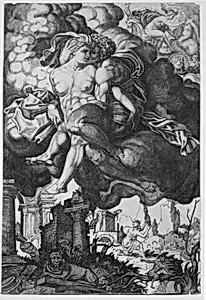
Ixion attempting to seduce Juno, surrounded by clouds with ruins below
Medium
Engraving
Dimensions
Sheet: 10 5/16 × 6 15/16 in. (26.2 × 17.6 cm)
Classification
Prints
Department
Drawings and Prints
Museum
Metropolitan Museum of Art, New York, NY
Credit
The Elisha Whittelsey Collection, The Elisha Whittelsey Fund, 1954
Accession Number
54.573.5
Rights
Public Domain
Tags
Art Historical Context
This striking engraving captures a dramatic moment from classical mythology: Ixion, the Thessalian king, attempting to seduce Juno (the Roman goddess Hera) amid billowing clouds, with ancient ruins visible below. Created 1520–39, the work reflects the Renaissance fascination with Greco-Roman legends, which often served as vehicles for exploring themes of desire, hubris, and divine retribution. Ixion’s tale ends in punishment—he was bound to a fiery wheel—yet here the focus rests on the tense encounter, enriched by symbolic details such as lions, chariots, and a nude female figure evoking Juno’s celestial realm. The print was engraved by Giovanni Jacopo Caraglio after a design by Perino del Vaga, a leading Mannerist painter. Engravings like this played a vital role in spreading artistic ideas across Europe, allowing intricate compositions to reach wide audiences beyond the original fresco or painting. Caraglio’s precise line work brings depth to the swirling clouds and architectural fragments, showcasing the medium’s ability to translate painterly drama into fine, reproducible detail. Housed in the Metropolitan Museum of Art’s collection, this sheet exemplifies how 16th-century printmakers bridged mythology and visual storytelling, inviting viewers to contemplate both the beauty and the moral lessons of ancient tales.
About the Artist
Giovanni Jacopo Caraglio|Perino del Vaga (Pietro Buonaccorsi) · 1500–1565
Italian, Parma or Verona ca. 1500/1505–1565 Krakow (?)