
Medium
Classification
Department
Smithsonian Collection
Museum
Smithsonian American Art Museum
Credit
National Portrait Gallery, Smithsonian Institution; gift of Mr. and Mrs. Paul Mellon
Accession Number
S/NPG.74.39.6.46
Rights
Public Domain
Tags
Art Historical Context
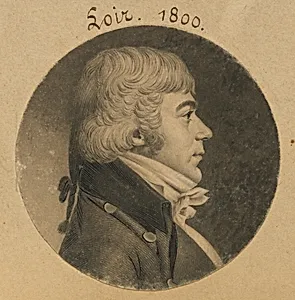
In 1800, French-born artist Charles Balthazar Févret de Saintémin crafted this elegant print portrait of J. B. Loir, capturing the subject's profile with remarkable precision. Saint-Mémin (1770–1852), who emigrated to the United States after the French Revolution, specialized in miniature profile likenesses that became a hallmark of early American portraiture. Working primarily in Philadelphia and New York, he documented the faces of politicians, merchants, and cultural figures during the young republic's formative years. The artwork's medium—a finely detailed print—highlights Saint-Mémin's innovative technique. He used a mechanical "physiognotrace" device, a pantograph-like tool, to trace silhouettes accurately from life, then engraved and often hand-colored them for reproduction. This method made high-quality portraits affordable and portable, blending Enlightenment-era science with neoclassical aesthetics. Profiles evoked ancient Roman coins, symbolizing virtue and permanence in a democratic age. Today, housed in the Smithsonian American Art Museum as part of the National Portrait Gallery's collection (gifted by Mr. and Mrs. Paul Mellon), *J. B. Loir* offers visitors a window into 19th-century elite society. It reminds us how prints democratized portraiture, preserving personal stories amid America's rapid transformation.