
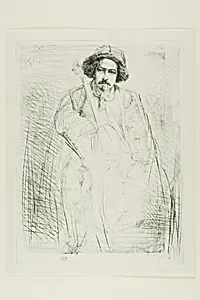
J. Becquet, Sculptor
Medium
Etching and drypoint with foul biting in black ink on ivory laid paper
Dimensions
Plate: 25.5 × 19.1 cm (10 1/16 × 7 9/16 in.); Sheet: 28 × 21.6 cm (11 1/16 × 8 9/16 in.)
Classification
etching
Department
Prints and Drawings
Museum
Art Institute of Chicago
Accession Number
73651
Rights
Public Domain
Art Historical Context
James McNeill Whistler’s *J. Becquet,or* (1859) captures the intensity of French artist Jacques Becquet at work in his studio, rendered with Whistler’s signature subtlety. Created during Whistler’s formative years in Paris, this etching belongs to his acclaimed “French Set,” a series portraits celebrating the everyday lives of artisans and colleagues. Whistler, an American expatriate who later championed Aestheticism in London, drew inspiration from French Realists like Courbet, blending sharp observation with atmospheric elegance. The print masterfully employs etching and drypoint techniques on ivory laid paper. Etching involves acid biting into a metal plate to form precise lines, while drypoint adds velvety burrs from direct needle scratches, creating rich textures. Subtle “foul biting”—unintended acid pitting—lends a gritty, organic depth, mimicking Becquet’s sculptural workspace. At 25.5 × 19.1 cm, its intimate scale invites close viewing, showcasing Whistler’s printmaking prowess akin to Rembrandt’s. Housed in the Art Institute of Chicago’s Prints and Drawings department, this work highlights Whistler’s early innovation in etching, bridging Realism and his later impressionistic harmony. It offers visitors a window into 19th-century Parisian bohemia, where art and craft intertwined.
About the Artist
James McNeill Whistler · 1834–1903
James Abbott McNeill Whistler (1834-1903) was an American-born painter and printmaker who became a leading figure in the Aesthetic Movement and pioneer of Tonalism and Japonisme. He revolutionized art by championing "art for art's sake" and treating paintings as visual equivalents of musical compositions, titling works as "arrangements," "harmonies," and "nocturnes" to emphasize formal qualities o...