
Jacob Balthazar Schitz
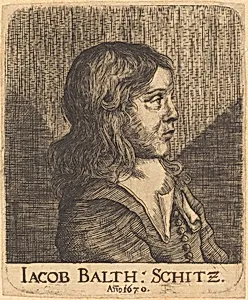
Medium
etching on laid paper
Dimensions
plate: 7.6 x 6.4 cm (3 x 2 1/2 in.) sheet: 7.7 x 6.5 cm (3 1/16 x 2 9/16 in.)
Classification
Department
CG-E
Museum
National Gallery of Art, Washington, D.C.
Credit
Gift of John O'Brien
Accession Number
1997.132.2
Rights
Public Domain
Art Historical Context
This delicate etching, titled *Jacob Balthazar Sch* and created by an anonymous German artist in 1670, the essence of 17th-century portraiture in a remarkably intimate scale—measuring just 7.6 x 6.4 cm on the plate. Produced on laid paper, a handmade variety common in the period with its characteristic chain lines visible under light, this print exemplifies the technical precision of Baroque-era printmaking. Etching, the chosen medium, involved coating a metal plate with acid-resistant ground, incising lines that the acid would etch away, allowing for fine, expressive lines ideal for detailed facial features and textures. In the context of 17th-century Germany, amid the flourishing Baroque style influenced by artists like Rembrandt, such small-scale prints served as affordable disseminators of likenesses, bridging elite portraiture with wider audiences. This work likely commemorates a notable figure of the time, reflecting the era's emphasis on individualized identity and status. Housed in the National Gallery of Art's Department of Prints (CG-E) as a gift from John O'Brien, it highlights the enduring value of modest yet masterful prints in preserving cultural history. (198 words)