
Jacob Meyer-Heine
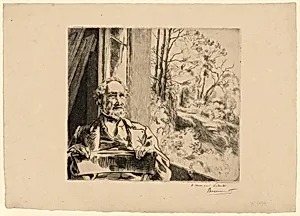
Medium
etching on laid paper
Dimensions
sheet: 29.6 × 41.5 cm (11 5/8 × 16 5/16 in.) plate: 21.9 × 24.5 cm (8 5/8 × 9 5/8 in.)
Classification
Department
CG-E
Museum
National Gallery of Art, Washington, D.C.
Credit
The Helena E. M. Gunnarsson Fund
Accession Number
2023.64.1
Rights
Public Domain
Art Historical Context
Félix Bracquemond's *Jacob Meyer-Heine* (1872) is a striking etching on laid paper, capturing the essence of its sitter with masterful precision. Measuring 29.6 × 41.5 cm overall, with a plate size of 21.9 × 24.5 cm, this print exemplifies the intimate scale typical of 19th-century etchings, allowing for intricate detail and tonal subtlety. Housed in the National Gallery of Art Prints department, acquired through the Helena E. M. Gunnarsson Fund, it invites visitors to appreciate the tactile quality of laid paper, whose visible chain lines echo traditional papermaking techniques favored by fine printmakers. Bracquemond, a pivotal French artist of the etching revival, drew from his deep engagement with Japanese prints and realist portraiture to create works like this. Etching—a process where acid bites into a metal plate along incised lines—enabled him to achieve rich, velvety textures and expressive lines, revolutionizing printmaking in post-1870 France amid the rise of Impressionism. This portrait likely honors Jacob Meyer-Heine, reflecting the era's fascination with distinguished patrons and intellectuals. As a classified print, *Jacob Meyer-Heine* highlights etching's democratic appeal: affordable yet artistic multiples that brought high-quality imagery to wider audiences. Its presence in a major collection underscores Bracquemond's enduring legacy in bridging painting and graphics.
About the Artist
Félix Bracquemond · 1833–1914
French, Paris 1833–1914 Sèvres